Medically reviewed by: Radhakrishnan Ramaraj, MD, FSCAI, Board-Certified Interventional Cardiologist & Endovascular Specialist, Champion Health System. Fellowship-trained at Cedars-Sinai/UCLA and Yale, with vascular interpretation training at Brigham and Women’s Hospital, Harvard University. Fellow of the Society for Cardiovascular Angiography and Interventions (FSCAI).
If chronic elbow pain is making it difficult to work, exercise, play golf or tennis, grip objects, turn a doorknob, or perform everyday activities, you may have options beyond repeated injections or surgery.
At Champion Health System, we evaluate patients with persistent elbow and tendon pain from across North Carolina, including Raleigh, Durham, Cary, Wake Forest, Oxford, Henderson, Dunn, Fayetteville and surrounding communities.
For appropriately selected patients with chronic tennis elbow or golfer’s elbow that has not responded to conservative treatment, musculoskeletal embolization may provide a minimally invasive treatment option.
Musculoskeletal embolization is an image-guided procedure designed to target abnormal blood vessels associated with certain chronic musculoskeletal conditions.
Champion Health System provides evaluation and treatment through our North Carolina locations in Raleigh, Oxford, Henderson and Dunn.
What Causes Chronic Elbow Pain?
Two of the most common causes of persistent elbow pain are:
Tennis Elbow — Lateral Epicondylitis
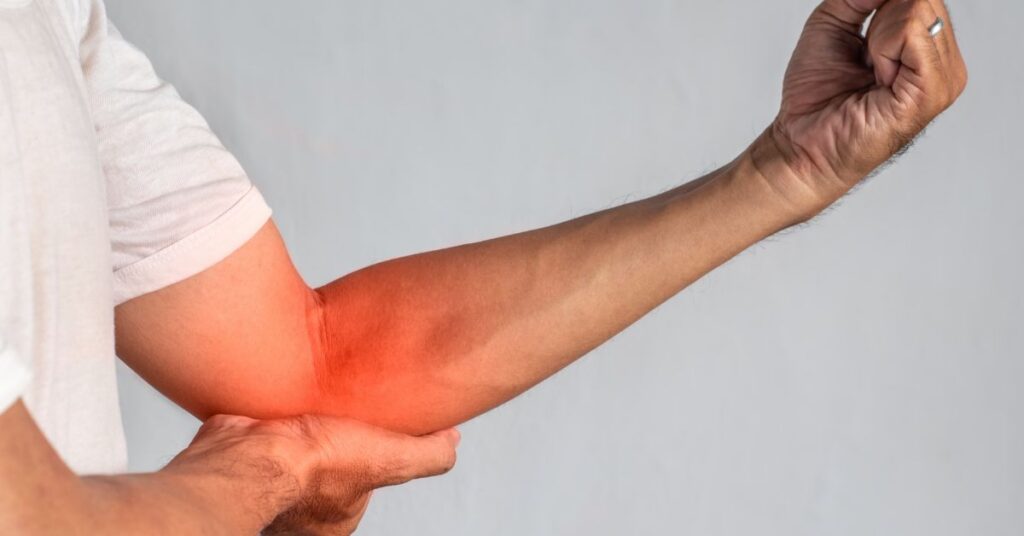
Tennis elbow typically causes pain along the outside of the elbow. Despite its name, you do not have to play tennis to develop it.
Repetitive gripping, lifting, construction work, weight training, racquet sports, computer work and other repetitive activities may contribute to the condition.
Golfer’s Elbow — Medial Epicondylitis
Golfer’s elbow generally causes pain along the inside of the elbow.
It can occur after repetitive gripping, throwing, lifting or other activities that repeatedly stress the tendons attaching to the inside of the elbow.
Why Does Elbow Pain Sometimes Become Chronic?
Persistent tennis elbow and golfer’s elbow are not always simply ongoing inflammation.
With chronic tendinopathy, the affected tendon may develop degenerative changes and abnormal small blood vessels, a process called neovascularization.
These abnormal vessels may be accompanied by sensory nerve fibers that can contribute to persistent pain. This provides one rationale for using embolization to treat carefully selected patients with chronic musculoskeletal pain.
What Is Elbow Embolization?
Elbow embolization, also known as musculoskeletal embolization, is a minimally invasive image-guided procedure intended to reduce abnormal blood flow associated with painful chronic tendon disease.
During catheter-based embolization, a physician accesses an artery through a small puncture and carefully guides a small catheter toward the blood vessels supplying the painful area.
The abnormal vascularity associated with the diseased tissue is identified and selectively treated.
The objective is to reduce the abnormal blood flow and associated pain signals while preserving normal circulation to surrounding healthy tissue.
Learn more about Musculoskeletal Embolization at Champion Health System.
Can Embolization Treat Tennis Elbow?
For appropriately selected patients, musculoskeletal embolization may be considered when chronic tennis elbow has not improved despite conservative treatment.
Patients frequently come to Champion Health System after trying treatments such as:
- Rest and activity modification
- Ice or anti-inflammatory treatment
- Elbow braces
- Physical therapy
- Exercise programs
- Corticosteroid injections
- Other image-guided injections
These treatments remain appropriate first-line therapies for many patients.
However, persistent symptoms may warrant additional evaluation to determine why the elbow has not improved.
Can Embolization Treat Golfer’s Elbow?
Patients with persistent medial epicondylitis, or golfer’s elbow, may also be evaluated for musculoskeletal embolization.
The treatment decision depends on the patient’s symptoms, examination, imaging findings, previous treatments and the condition of the affected tendon.
Not every patient with golfer’s elbow requires or qualifies for embolization.
Who May Be a Candidate for Elbow Embolization?
You may be considered for treatment if you have:
- Chronic elbow pain lasting several months
- Tennis elbow or golfer’s elbow
- Persistent symptoms despite appropriate conservative treatment
- Pain interfering with work, exercise, sports or everyday activities
- Imaging findings consistent with chronic tendinopathy
- Abnormal vascularity or neovascularization when demonstrated on appropriate imaging
- A desire to explore minimally invasive alternatives before surgery
A consultation and appropriate diagnostic evaluation are necessary to determine whether embolization is suitable for your condition.
How Champion Health System Evaluates Chronic Elbow Pain
At Champion Health System, treatment begins with determining why your elbow hurts rather than automatically recommending a procedure.
Your evaluation may include:
- Review of your symptoms and previous treatments
- Physical examination
- Review of previous X-rays, ultrasound or other imaging
- Musculoskeletal ultrasound when appropriate
- Evaluation for abnormal tendon vascularity
- Assessment for tendon tears or other structural abnormalities
- Discussion of conservative, interventional and surgical options
This evaluation helps determine whether embolization is appropriate or whether another treatment would be more suitable.
What Happens During Elbow Embolization?
Depending on the treatment approach selected for an individual patient, embolization may be performed using image guidance to identify and treat abnormal blood vessels associated with the painful tissue.
The treatment is designed to be highly targeted.
Because embolization is minimally invasive, it generally does not require the large incision associated with traditional open surgery.
Patients are monitored after treatment and receive individualized instructions regarding activity and recovery.
What Is Recovery Like After Elbow Embolization?
Recovery varies from patient to patient.
Because treatment is minimally invasive, many patients can return to light activities relatively quickly. Your physician will provide specific instructions regarding exercise, lifting, work and return to sports.
Improvement may occur gradually as the abnormal vascular response decreases following treatment.
Individual results vary, and no procedure can guarantee complete pain relief.
Elbow Embolization vs. Elbow Surgery
For patients with chronic tennis elbow or golfer’s elbow who have failed conservative treatment, surgery may eventually be considered.
Musculoskeletal embolization offers appropriately selected patients a minimally invasive treatment option that may be considered before surgery. Unlike open surgery, embolization is performed through a small access site and does not require surgical removal or repair of tendon tissue.
However, patients with significant tendon rupture, structural damage or other conditions may still require orthopedic treatment or surgery. The goal is to select the treatment that best matches the underlying problem.
Why Choose Champion Health System for Elbow Pain Treatment in North Carolina?
Champion Health System specializes in image-guided cardiovascular, endovascular and musculoskeletal interventions.
Our approach combines advanced imaging, vascular expertise and minimally invasive treatment techniques to evaluate chronic musculoskeletal pain.
Specialized Endovascular Expertise
Radhakrishnan Ramaraj, MD, FSCAI is a board-certified interventional cardiologist with advanced training in endovascular intervention.
His postgraduate training includes cardiovascular training at Cedars-Sinai and advanced interventional and vascular training at Yale.
He has also pursued additional education in musculoskeletal embolization, including visiting the clinic of Dr. Yuji Okuno in Japan, a pioneer in musculoskeletal embolization techniques.
Minimally Invasive Focus
Our goal is to determine whether a patient’s condition can be treated using a minimally invasive approach while avoiding unnecessary surgery whenever clinically appropriate.
Multiple North Carolina Locations
Patients can access Champion Health System throughout central and eastern North Carolina.
Elbow Pain Treatment in Raleigh, NC
Champion Health System’s Raleigh/Brier Creek clinic evaluates patients with chronic elbow, joint and tendon pain from Raleigh and surrounding communities, including:
Raleigh • Cary • Durham • Morrisville • Wake Forest • Apex • Holly Springs • Fuquay-Varina • Garner • Knightdale
Champion Health System — Raleigh/Brier Creek
7901 ACC Blvd, Suite 102
Raleigh, NC 27617
Phone: (919) 651-4345
Elbow Pain Treatment in Oxford, NC
Our Oxford location serves patients from Granville County and surrounding areas, including:
Oxford • Roxboro • Creedmoor • Butner • Durham • Wake Forest • Louisburg • South Hill and Southern Virginia
Phone: (919) 339-4077
Elbow Pain Treatment in Henderson, NC
Champion Health System also serves patients from Henderson and surrounding communities, including:
Henderson • Oxford • Louisburg • Warrenton • Roanoke Rapids • Clarksville and surrounding areas
Champion Diabetic Wound & Limb Preservation Center
(252) 572-4223
Internal Medicine & Geriatrics
(252) 492-6127
Elbow Pain Treatment in Dunn, NC
Our Dunn location serves patients throughout Harnett County and southeastern North Carolina, including:
Dunn • Fayetteville • Benson • Smithfield • Clayton • Fuquay-Varina • Lillington • Clinton • Sanford • Goldsboro
Phone: (910) 304-1212
Frequently Asked Questions About Elbow Embolization
What is the best treatment for chronic tennis elbow?
Treatment depends on the underlying cause and severity. Initial treatment commonly includes activity modification, physical therapy, bracing and other conservative therapies. Patients with persistent symptoms may benefit from additional imaging and specialist evaluation to determine whether treatments such as musculoskeletal embolization or surgery should be considered.
Is there a non-surgical treatment for tennis elbow?
Yes. Many cases can be treated without surgery. Options may include physical therapy, activity modification, bracing, injections and, for appropriately selected patients with persistent symptoms, minimally invasive musculoskeletal embolization.
What is tennis elbow embolization?
Tennis elbow embolization is an image-guided treatment designed to target abnormal blood vessels associated with chronic tendinopathy. It is one application of musculoskeletal embolization.
Does elbow embolization require surgery?
Embolization is a minimally invasive image-guided procedure rather than traditional open surgery.
Can embolization treat golfer’s elbow?
Some patients with persistent medial epicondylitis may be candidates. Appropriate patient selection and imaging evaluation are important before recommending treatment.
How do I know if I am a candidate?
A specialist needs to review your symptoms, physical examination, previous treatment and imaging. Ultrasound or MRI may be recommended depending upon your condition.
Where is elbow embolization available in North Carolina?
Champion Health System evaluates patients for musculoskeletal embolization through its locations in Raleigh, Oxford, Henderson and Dunn, North Carolina.
Chronic Elbow Pain Doesn’t Have to Control Your Life
If you have been living with tennis elbow, golfer’s elbow or another form of persistent elbow pain despite physical therapy, bracing, injections or other treatments, consider getting another evaluation.
The specialists at Champion Health System can determine the cause of your pain and whether a minimally invasive treatment such as musculoskeletal embolization may be appropriate.
Schedule an Elbow Pain Consultation
Raleigh/Brier Creek: (919) 651-4345
Oxford: (919) 339-4077
Dunn: (910) 304-1212
Henderson: (252) 572-4223
Champion Health System
Advanced Cardiovascular, Endovascular & Musculoskeletal Care in North Carolina